2026-06-27
On June 23, 2026, the Cyberspace Administration of China, the People's Bank of China, and four other ministries and commissions jointly issued the Guidelines for Classification and Gradation of Financial Information Service Data, establishing the first systematic data classification and gradation framework specifically for the financial information service sector. This marks a new era in financial information service data management—transitioning from "general‑purpose protection" to "precision governance." For financial institutions, how can they rapidly build a matching disaster recovery system? This article provides an in‑depth interpretation of the Guidelines' key points and, together with the UNISPACE enterprise‑grade backup and disaster recovery solution, offers a practical compliance implementation roadmap.
Level 1: Core Data
This is the highest protection level. Any leakage, tampering, corruption, or unlawful access or use of such data would cause severe harm to national security. It requires the strictest access control and protection measures.
Level 2: Important Data
Data whose security incidents would cause moderate harm to national security, economic operations, social order, or public interests, or would cause serious damage to the rights and interests of organizations or individuals. Important data requires prioritized protection and is a key area for financial institutions' security investment.
Level 3: Sensitive General Data
This is a sub‑category of general data tailored to the financial sector. Any leakage or tampering would have a certain impact on economic operations, social stability, public interests, or would materially affect the rights and interests of organizations or individual citizens.
Typical examples: non‑public private equity fund data, foreign exchange data involving the Renminbi, etc.
Level 4: Regular General Data
All other financial information service data with the lowest level of harm beyond the above three categories. For example, publicly available basic trading data for stocks and bonds falls into this level.
| Business Data | ||
| User Data | ||
| Enterprise Data | ||
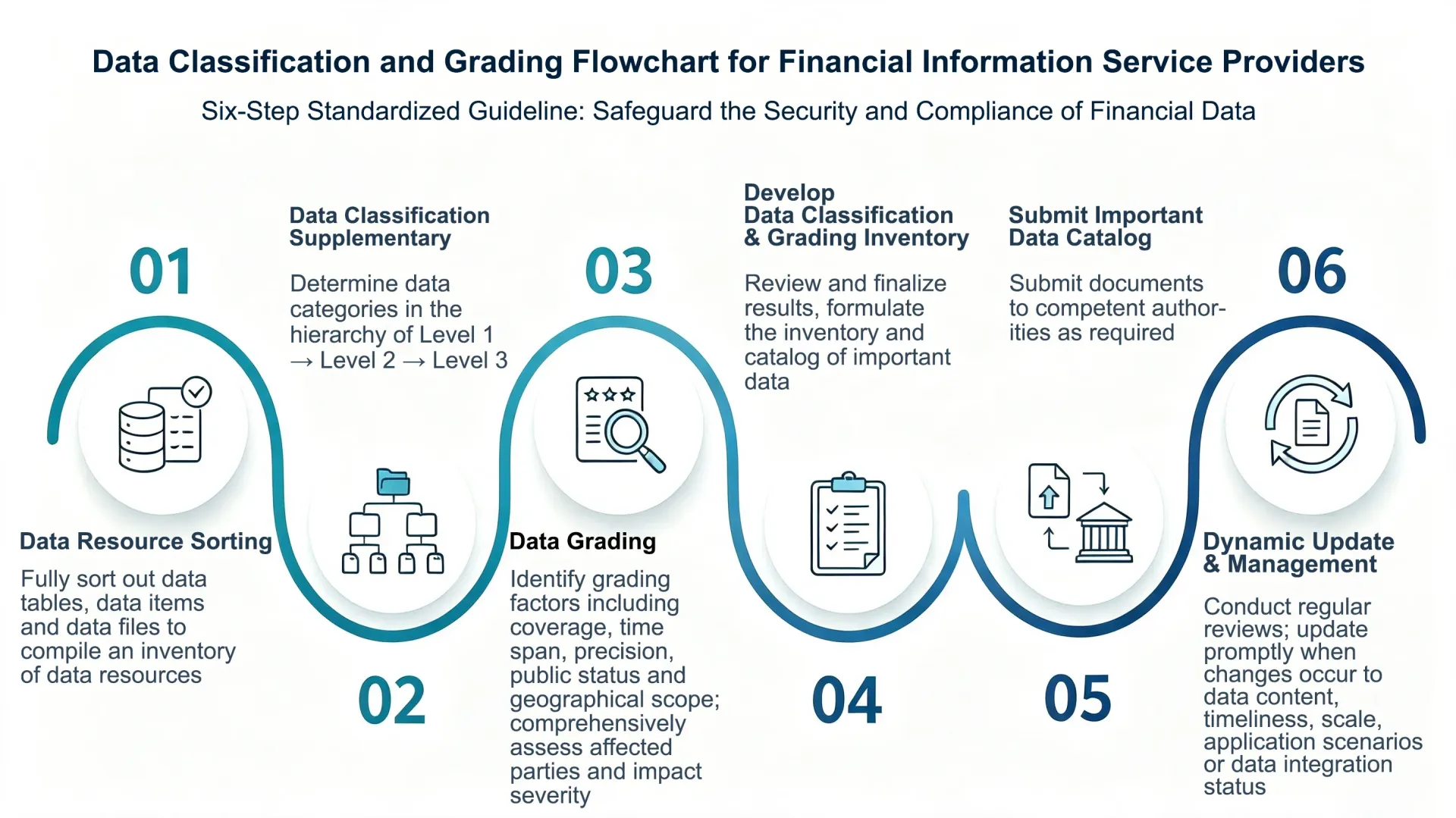
The Guidelines specify a six‑step process to be followed by financial information service providers:
| Data Backup | ||
| Backup Verification | ||
| Remote Disaster Recovery | ||
| Log Retention | ||
| Encryption Security | ||
| Encryption Security | ||
| Dynamic Update |
UNISPACE is an enterprise‑grade backup and disaster recovery solution for next‑generation data centers and multi‑cloud environments. With its product attributes of "unified platform, elastic deployment, and intelligent automation," UNISPACE's four‑layer security resilience architecture closely aligns with the tiered protection requirements of the Guidelines, enabling financial information service providers to rapidly build compliant disaster recovery systems.
| Architecture Security | ||
| Link Security | ||
| Data Security | ||
| Replica Security |