2026-09-11
August 17, 2026 — Yuanshuo Technology officially launched UNISPACE 3.4, its enterprise‑grade data protection software. The new release delivers systematic upgrades across four dimensions: expanded database ecosystem, broader virtualization platform coverage, data verifiability, and platform operability. It further strengthens data protection capabilities for scenarios based on the information‑technology innovation (ITI) ecosystem and hybrid IT architectures. This article interprets the core technical features of UniSpace 3.4.
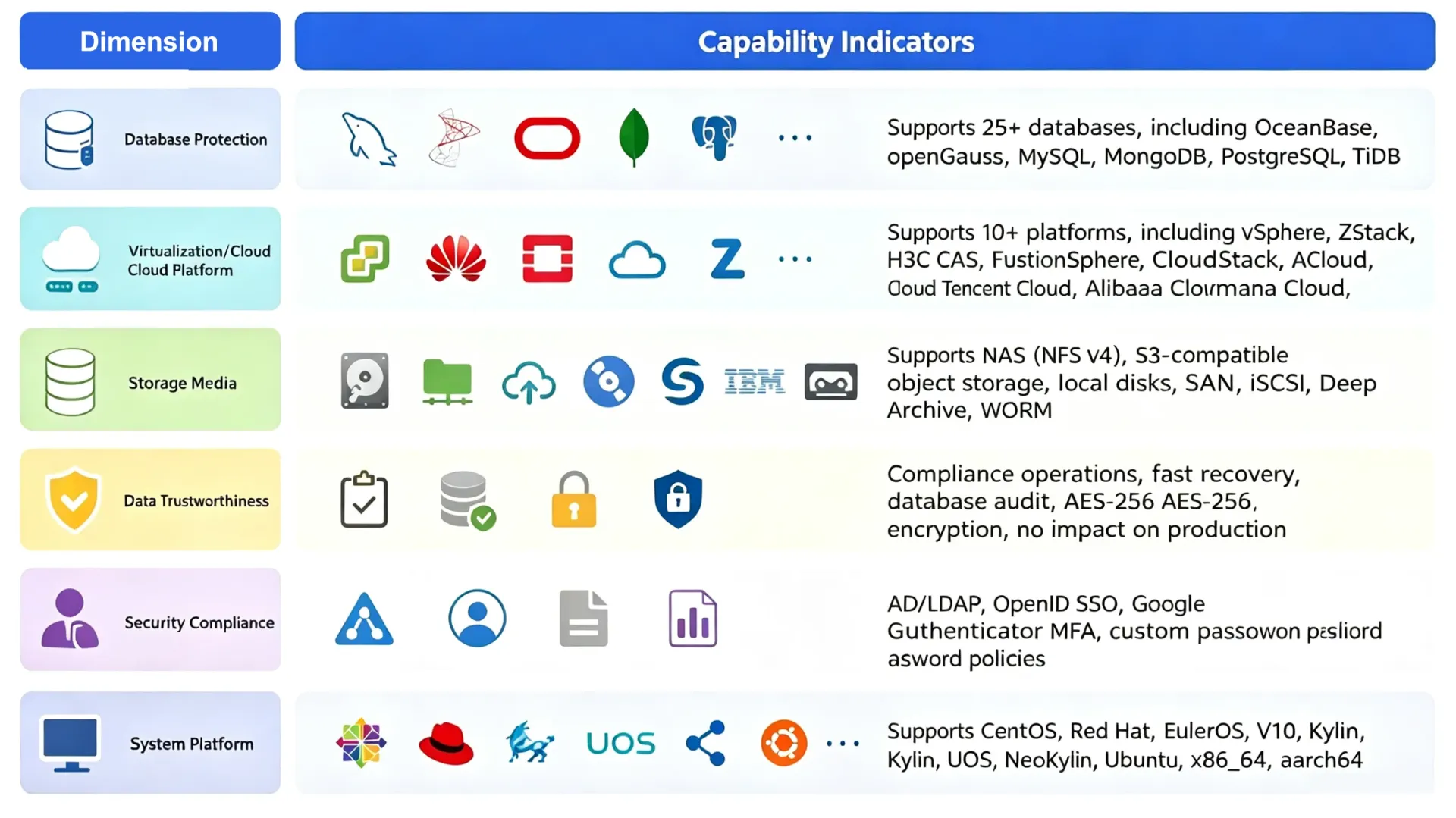
| Dimension | Capability Metrics |
|---|---|
| Database Protection | Supports over 20 databases; newly adds OceanBase, openGauss, MogDB, Hailiang DB, and Panwei DB |
| Virtualization / Cloud Platform | Supports more than 10 platforms; newly adds ZStack Sphere |
| Storage Media | Local storage, NAS (NFS v3/v4), S3 object storage, Blu‑ray storage, StorNext, IBM Storage Deep Archive, WORM |
| Data Trustworthiness | Two‑level job validation (Fast / Deep), deduplication repository data validation, AES/SM4 encryption, WORM immutable storage |
| Security & Compliance | AD/LDAP/OpenID SSO, Google Authenticator MFA, operation auditing, custom reports |
| System Platform | Compatible with CentOS, RHEL, Kylin V10, UnionTech UOS, openEuler, Ubuntu, etc.; supports x86_64 / aarch64 architectures |
With the in‑depth advancement of ITI replacement, enterprises are operating increasingly diversified database environments. UNISPACE 3.4 adds backup‑and‑recovery support for five domestic databases: OceanBase, openGauss, MogDB, Hailiang DB G100, and Panwei DB. The total number of protected databases reaches 20, covering both mainstream international databases (Oracle, MySQL, SQL Server, PostgreSQL, Informix) and domestic databases (GoldenDB, TDSQL, OceanBase, Dameng DM, KingBase, GBase 8s, GBase 8c, HighGo, YashanDB, KingWow, Xihe, and others).
Highlights for newly‑added OceanBase: Compatible with both distributed and centralized deployments. It supports full backup and log backup; log archive paths support NFS and S3 protocols. Backup workflows do not rely on OCP (OceanBase Cloud Platform) and can integrate directly with existing O&M systems. For recovery, local recovery, cross‑host recovery, log‑based recovery, and database‑plus‑log‑dump recovery are available.
Newly‑supported openGauss‑family databases (openGauss / MogDB / Hailiang DB / Panwei DB): Supports standalone and master‑slave replication architectures. Two backup modes are provided: dumpbase and filebase. Local and cross‑host recovery scenarios are supported. Distributed deployment is not yet covered in this release; this capability is on the roadmap for future versions.
MySQL: Dual‑engine support for mysqldump and xtrabackup. xtrabackup‑based incremental backup and recovery, point‑in‑time full‑instance recovery, and selective single‑database recovery from full‑instance backups. Cluster management supports 1‑master‑1‑slave / 1‑master‑multi‑slave topologies with priority configuration. Backup jobs remain unaffected during master‑failover events.
Oracle: Full support for standalone, RAC, and replicated‑cluster architectures. RAC enables parallel backup across single or multiple cluster nodes. Recovery supports point‑in‑time recovery and SCN‑specified recovery.
Dameng DM: Supports master‑slave replication, read‑write separation, and DSC architecture. Backup can be performed in virtual‑machine‑cluster mode with configurable node‑level priority and concurrency. Recovery supports redirection, point‑in‑time recovery, and LSN‑specified recovery.
GoldenDB: Covers centralized and distributed deployments. Supports combined backup of metadata, GTM nodes, active transaction files, plus shard data and logs. Complete instance‑level and shard‑level recovery workflows are implemented.
UNISPACE 3.4 introduces agent‑less backup‑and‑recovery for the ZStack Sphere platform (x86_64 only). The scope of supported virtualization and cloud platforms expands to ten: VMware vSphere 6.7/7.x/8.x, OpenStack Q and later, Huawei HCS 8.1.x/8.3.x, SmartX 6.x, Inspur InCloud, Inspur InCloud Sphere, Sangfor HCI, H3C UIS Hyper‑Converged, and ZStack Sphere.
Cross‑Platform Recovery: VMware‑originated backups can be restored to H3C UIS Hyper‑Converged, Inspur InCloud Sphere, and Sangfor HCI. Addressing VMware replacement and platform‑migration requirements, UNISPACE leverages existing backup copies as migration intermediaries. No extra migration tooling is required on production environments; existing backup datasets can restore virtual machines onto domestic hyper‑converged infrastructures.
LiveMount Instant‑Access: Virtual machines on VMware / H3C UIS / InCloud Sphere can be directly mounted and booted from backup copies. After mounting completes, automatic vMotion migrates workloads to target datastores. This delivers “minute‑scale business startup plus background transparent data remigration”, drastically lowering RTO for mission‑critical services.
All above‑mentioned platforms support agent‑less backup, grouped backup, full / incremental backup, local‑restore, renamed‑restore, and cross‑cluster restore. Leading platforms support granular recovery for both Linux and Windows target guests.
Recoverability of backup data must be verifiable and auditable. Building upon prior‑release job‑validation capabilities, UNISPACE 3.4 establishes a complete two‑tier validation system:
Fast Validation: Validates metadata job records on management nodes, volume lists from storage devices, and block‑index files. No backup payload data is read, resulting in low overhead for frequent routine inspections.
Deep Validation: On top of fast validation, backup payload data is read and CRC checksums are computed. Designed for periodic thorough validation of critical backup copies.
Deduplication Repository Data Validation: Fast validation parses block‑address pointers from volume indexes and verifies block existence. Deep validation reads physical blocks, computes CRC and hash values, and cross‑compares against deduplication‑repository records. For the first time, the deduplication repository — a core component of data protection — achieves verifiable internal data integrity.
Sparse‑File (Hole‑Punching) Backup Storage: Sparse‑file writes are supported within deduplication‑pool file systems to cut redundant storage consumption.
Deduplication Repository Archiving & Migration: Entire deduplication repositories can be archived and migrated natively, supporting media rotation, long‑term archiving, and compliance retention requirements.
Together with existing WORM immutable storage, pool‑level AES/SM4 encryption, and client‑side software encryption, UniSpace builds a full‑chain trusted‑data workflow: write‑time encryption → immutable storage → integrity validation → recoverability verification. This satisfies technical requirements for ransomware defense and cybersecurity classification‑protection compliance.
High‑Availability & Load‑Balancing: New storage‑node load balancing provides intelligent storage‑path selection and automatic failover, eliminating risks from single‑path overload and single‑points‑of‑failure.
Alerting & Observability: Email alert channels are newly supported; custom trigger conditions cover job failures, storage‑capacity thresholds, storage‑node offline status, and more. Two built‑in report templates are available, and users may write custom SQL for ad‑hoc reporting to deliver quantitative insights for capacity planning and operational analysis.
Fine‑Grained Scheduling: Operation windows can be defined per resource group. Jobs outside allowed windows automatically queue. Multiple enhancements apply to service‑plan and replica workflows: manually retained jobs, selective copy, default‑replica switching, copy‑plan‑to‑replica association, and backup‑set management under service‑plan dimensions.
Data‑Compression Policies: Compression can be configured at backup‑set granularity. Combined with replica‑level compression settings, they jointly determine runtime behavior (compression executes only when enabled on both backup‑set and replica layers), delivering clear policy semantics and predictable outcomes.
Identity Authentication & Auditing: SSO via AD / LDAP / OpenID is supported; Google Authenticator MFA multi‑factor authentication is added. Operation auditing covers user management, storage‑pools, service‑plans, and backup objects (clients, instances, backup‑sets), meeting Class‑2 Cybersecurity Protection and internal‑control‑audit requirements.
With this engine, users can assemble automated pipelines of “Backup → Copy → Recovery Validation → Notification”. Recovery drills can be standardized and institutionalized, transforming backup‑availability validation from periodic manual work into continuously running
system‑driven capability.
The data‑protection industry is undergoing a paradigm shift. Ransomware attacks target backup systems as primary attack surfaces. Regulators demand provable data integrity and recoverability. The ITI ecosystem sustains long‑term heterogeneous‑infrastructure coexistence. Meanwhile, AI elevates corporate data to a new‑level strategic asset. Against this backdrop, Yuanshuo Technology defines three strategic directions for UniSpace product evolution:
First, to become a trusted data‑protection foundation within the ITI ecosystem. Combinations of domestic databases, operating systems, and virtualization platforms will keep diversifying. UniSpace will closely follow ecosystem updates, implement rapid adaptations, and conduct thorough validation — ensuring customer infrastructure choices are never constrained by data‑protection limitations.
Second, to make recoverability a measurable, auditable engineering metric. A “successful backup‑job status” does not guarantee recoverable data. Two‑tier validation, recovery plans, LiveMount, and automated drills powered by graphical workflows enable UniSpace to convert RTO/RPO from service‑level commitments into continuously‑validated, auditable engineering facts.
Third, to evolve into a next‑generation data‑management platform for the AI era. Backup systems host enterprises’ most complete sets of data copies and metadata. As Copy‑Data‑Management (CDM) converges with AI technologies, these data assets unlock incremental value across scenarios including data governance, compliance analytics, development‑and‑test data provisioning, and model training. UniSpace will keep investing in this direction, advancing data‑protection systems from cost centers toward data‑asset‑operation platforms.
Data is invaluable; resilience comes first.
UNISPACE 3.4 is now officially released. For product documentation, trial applications, or full compatibility lists, please contact Yuanshuo Technology customer service: support@yuanshuotech.com